The Science of Being Wrong

Image from the Mars Curiosity Rover appears courtesy of NASA


I've had several conversations with people that don't see the point of sending a Rover to Mars. The criticism I've heard most is "what if we don't find the signs of life that we're looking for? Will the mission still be worth it"?

Yep.

Curiosity is essentially a full laboratory on wheels. It will analyze everything it finds, so we will learn more about the surface of Mars than we have ever known. As we yearn to understand the beginnings of the universe and where we all come from, we need as much information as possible, even if it doesn't seem obvious at this point. The knowledge will lay the path for future generations to explore the universe in ways that we could only dream of.

NPR has a great article entitled "Science is Sometimes Wrong, For All of the Right Reasons". From the article:

In order to move forward, a scientist must have the courage to take the risk of being wrong. You stick your neck out so that you can perhaps see a bit farther than the others.

Google's Nexus 7 Tablet Has Defeated My iPad


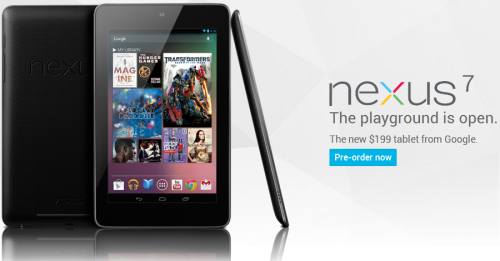
For the last few weeks, I've been using the Google Nexus 7 tablet as my main tablet experience, instead of my iPad. For $200, you get the best bang for your buck compared to the $500 new iPad (or $400 iPad 2)

Just to be clear, tablets are not laptop replacements - they are somewhat "fun" accessories to your main computer. It's great for taking things on the go. And Google has hit the nail on the head in terms of size, power, and battery life.

The Nexus is a 7 inch tablet that offers great portability without significantly sacrificing visual detail. It feels like a book in your hands, which makes it easier to pull out while on a subway or late night reading in the bed. It makes the 10 inch iPad feel unwieldly in comparison.

Being smaller helps. The 7 inch form factor also offers a better gaming experience. Many games that I tend to like - such as side scrolling platformers like Sonic the Hedgehog or first person shooters like Modern Combat - have touch screen versions of control pads and buttons, and it's more comfortable to wrap your hands around a 7 inch device than a 10 inch one.

I enjoy being able to download any file from the internet, even if I can't open it on the Nexus. I can hook it up to a omputer and drag and drop files from the tablet to the computer and vice versa, instead of having to go through iTunes. I can install a video game emulator and play old Nintendo games with a Nintendo Wii controller, something not possible on an iPad. It really feels like connecting a huge flash drive to your computer.

The biggest issue I have with the Nexus 7 is preventing your tablet from slowing to a crawl because too many applications are open. You have to either visit the "Apps" section in settings which is like Task Manager in Windows, or you need to download a third party Task killer application. I went with the latter, and tasks restart after being killed. I found my tablet getting slower and slower, something that was easier to remedy on the iPad.

So the verdict? Power users with some money may still prefer the iPad, but the vast majority of folks should go Nexus 7. It's half the price and close enough in terms of power and available apps to make it the best deal. Just make sure to read up on how to properly close programs so your tablet doesn't slow to a crawl and you'll be good to go!
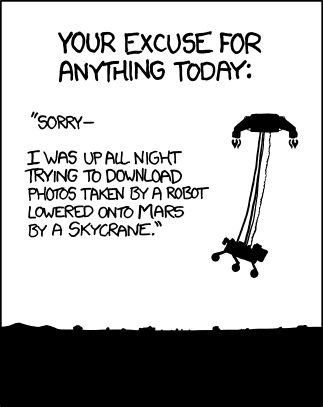
Curiosity Lands With an Awesome Crane

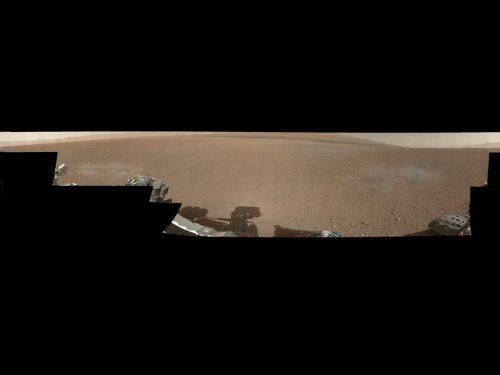
The NASA Curiosity rover has successfully landed on the surface of Mars, helping to thrust the USA back into the space spotlight in a major way for the first time since the shuttle program ended a year ago. As usual, humor site XKCD.com hits the nail on the head:

So why did NASA need a crane? The spacecraft carrying the rover had to slow down its descent using the upward engines, but it couldn't get too low to the ground for fear of blowing dirt into the rover's sensitive machinery. Thus, NASA engineers decided to lower the actual rover from the hovering spacecraft to the surface using a crane. This is another example of the ingenuity of our space program to tackle problems that have never been dealt with before. Their creativity is astounding.

Next up: the search for signs of life! Let's go Curiosity

24 Hrs Until Mars Landing - Have Some Rovers


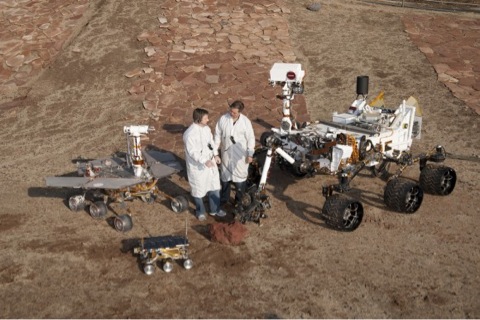
The above photo, courtesy of UniverseToday.com, shows all three generations of NASA Martian Rovers. The tiniest is Sojourner (1997), followed by the twins Spirit and Opportunity (2004), and finally Curiosity is the largest on the left. As you can see, they've been getting larger with age! This is mostly to hold increasingly complex laboratory and support systems needed to properly analyze the Martian surface.

At 1:24am EST on Monday morning, Curiosity will enter the Martian atmosphere and attempt to land. All of our fingers are crossed!

NASA Landsat 40th Anniversary Photos


On July 23rd, I traveled to DC to attend a NASA event celebrating the 40th anniversary of the Landsat program. The Landsat satellites provide valuable images of the planet for analysis of forests, natural disasters, etc. I joined other NASA twitter followers via the #NASASocial program at the Newseum (Washington, DC) and Goddard Flight Center (Greenbelt, MD).

Check out my coverage of the event below. Follow me on Twitter at @ShareefJackson or search the hashtags #NASASocial and #Landsat for tweets from other attendees.